18 Nov 2025
At Fibox, we’re continuously progressing on our ESG journey. This article highlights the concrete actions we’re taking to strengthen our ESG reporting practices.
Over the past few years, we’ve made significant strides in the field of ESG. A key part of this effort is developing processes that allow us to openly share our responsibility data to align with the evolving needs of our customers, partners and stakeholders.
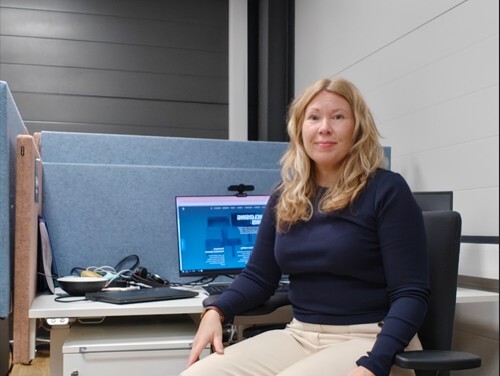
Tiina Kanerva, Group Financial Controller at Fibox, took charge of ESG reporting in the spring of 2025 in an interim capacity following the departure of the ESG Manager.
“It’s not typical for a financial controller to lead ESG reporting,” Kanerva explains. “I began this work alongside our former ESG Manager and will continue until a new one joins. Since we use the same system for financial reporting, it made sense that I consolidate our responsibility data there as well. I now collaborate closely with our Global HR Business Partner Mari Haapasaari, who oversees the HR aspects.”
First VSME standard report in the works, EcoVadis efforts continue
The importance of ESG has grown steadily in recent years. Increasingly, our customers—many of whom are publicly listed companies—require detailed sustainability data for their own reporting.
Fibox has already completed three years of GHG (greenhouse gas) reporting, which has provided valuable insights into areas where we can improve.
This year, we are preparing our first VSME standard report—a voluntary sustainability reporting framework for small and medium-sized enterprises developed by EFRAG and recommended by the European Commission. Fibox’s report will be both published and audited next year.
“My role is to ensure we have as much accurate data as possible for the VSME report. I also work closely with our auditors to make sure it provides a true picture of where we stand,” Kanerva says.
Compared with existing GHG reporting, the VSME report will offer a broader perspective—particularly of the social aspects of ESG—and will include new emission reduction targets set by the leadership team.
“The first report is really about finding out where we are now—to see where we need to improve,” Kanerva notes.
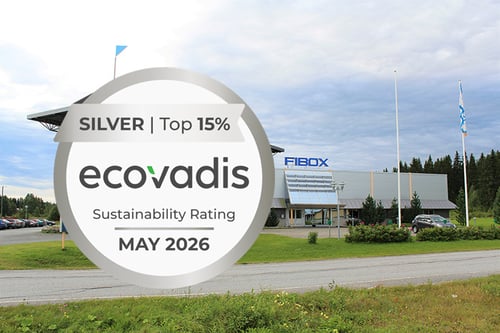
In 2023, Fibox earned the EcoVadis Bronze Medal in recognition of our sustainability achievements. This year, Kanerva and Haapasaari are once again compiling data for the EcoVadis assessment.
“The requirements become stricter every year, and maintaining certification takes more effort,” Kanerva says. “We’ve made great progress with policies, but now it’s about taking more concrete actions.”
Data consistency across regions and business units remains a
key focus
With subsidiaries around the world, ensuring data accuracy and consistency across regions and business units is a key focus at Fibox.
“At this point, data collection is still very manual,” Kanerva admits. “EcoVadis requires an enormous amount of data—even more than VSME, despite us working with the more extensive version of the VSME standard. The information spans working conditions, salaries, purchasing, subcontractors, and GHG calculations, which include emissions, water consumption, and more.”
There are also differences between regions and functions.
“In Finland, for instance, our HR system gives us high-quality social responsibility data, which we can use to calculate metrics like pay equality. In some other countries, such systems don’t yet exist. The EU’s new Pay Transparency Directive will also influence future system requirements,” Kanerva explains.
New report plays a key role in building a shared understanding of ESG
Kanerva believes that one of the most important steps right now is ensuring that everyone in the organisation understands the value of ESG work.
“Much of our responsibility and sustainability communication is directed towards employees. For example, our HR team has introduced new policies, such as the Code of Conduct.”
The audited VSME report will be instrumental in reinforcing the importance of collecting reliable data and aligning efforts across all geographies, business units and subsidiaries.
“We’re gaining more understanding and awareness every day. The VSME report will clarify our shared goals—what we need to do, and why transparency matters,” she emphasizes.
Looking ahead, Kanerva sees financial institutions as another key audience for ESG reporting alongside customers and employees.
“As the expectations of banks and investors rise, companies will need to demonstrate responsibility in action. Transparent ESG reporting will become essential to secure financing.”
Progress over perfection: ESG work continues
A lot has changed since Kanerva first joined Fibox five years ago. Even though progress can sometimes be slow, Kanerva sees the value in steadily moving forward towards shared goals.
“We’ve come a long way,” Kanerva reflects. “At first, we had no processes in place. Now, we’re in our third year of GHG calculations, we have an ESG Manager role, and we’re actively working on both EcoVadis and VSME. There’s still plenty to do, but the leadership team and owners are fully committed. The pace has really accelerated over the past six months. I’m proud of how much focus we’re putting into this."
For Kanerva, the most rewarding part of ESG reporting has been the broader perspective it has given her on the company’s operations.
“Responsibility touches everything! There are so many dimensions to it, and it’s given me a whole new understanding of the company and what accountability truly means. I’ve also enjoyed learning how different business units operate.”
This experience has also prompted her to reflect on the relationship between financial and ESG reporting.
“Finance and responsibility are deeply connected. Finance is all about numbers, while responsibility involves more nuance. It’s been a great experience as a finance professional to be part of this journey,” she concludes.